2026 · The preparation year · Limited assessment slots
CSRD & ESG · 2026 Practice Brief

The document the regulator requires is not the document the investor reads.

2026 is the preparation year. The design system you commit to now will carry every sustainability statement you publish for the next decade. Make it once. Make it correctly. Make it investor-grade.

For Wave 1 issuers · Wave 2 preparers · IR & Sustainability Officers

€450M+
Revised CSRD scope threshold
(net turnover, post-Omnibus)
1,000+
Employees threshold
under Omnibus revisions
2028·
First mandatory
Wave 2 report (FY2027)
iXBRL
Inline XBRL tagging required
from first report
01 · The Regulatory Reality

The scope shrank.
The standard did not.

After the Omnibus revisions of 2025, fewer companies are obliged to report. But every company that is obliged is now under a brighter spotlight — and the visual standard expected by investors, regulators and rating agencies has not been relaxed by a single millimetre.

Wave 1

Already reporting · refining the second cycle.

Large listed companies, banks and insurers that published their first CSRD statements in 2025 covering FY2024. Their 2026 reports — covering FY2025 — are the first opportunity to fix what the first cycle exposed: weak hierarchy, inconsistent typography, charts that do not survive a printed page.

Active obligation

Wave 2

2026 is preparation. 2028 is delivery.

The two-year delay introduced under Omnibus means most large unlisted companies (1,000+ employees, €450M+ turnover) now publish their first CSRD report in 2028, covering FY2027. The window between now and Q4 2027 is precisely when the document architecture is decided.

Preparation window

The Digital Layer

ESEF + Inline XBRL · from day one.

Every CSRD report must ship in XHTML enriched with Inline XBRL tagging, structured for the European Single Access Point (ESAP) launching July 2027. PDF accessibility (PDF/UA) for the human-readable companion document is no longer optional in regulated industries.

Technical floor
02 · Where you stand

Two scenarios.
Two decisions.

Whether your first CSRD report was filed last year or your first one ships in 2028, the design decision is the same: build a system you can defend through every cycle that follows — not a one-off document you will rebuild from scratch each year.

Scenario A · Wave 1

You filed your first CSRD report in 2025. The second one is coming.

Listed corporates, banks, insurers and other public-interest entities already inside the obligation.

Your first cycle produced a working document. Probably. But probably also exposed every weakness the first deadline forced you to ship past: charts assembled in Excel and pasted as images, inconsistent paragraph styles across chapters, an executive summary that reads like a regulatory annex instead of an investor narrative.

The 2026 report is the first chance to consolidate. Get the architecture right this cycle and every cycle after compounds the investment.

What now

  • Audit the FY2024 report against the 10-point investor-grade checklist
  • Rebuild the InDesign master with paragraph, character and table styles
  • Establish the Excel → InDesign data link so quarterly updates take hours, not weeks
  • Plan PDF/UA compliance for the human-readable PDF companion
Scenario B · Wave 2

Your first CSRD report ships in 2028. The architecture is decided in 2026.

Large unlisted companies — 1,000+ employees, €450M+ net turnover — entering CSRD for the first time.

The Omnibus delay gave you two extra years. It did not give you two extra years of complacency. It gave you the runway to build something most Wave 1 issuers wish they had: a document architecture designed before the deadline, not assembled under it.

The companies that use 2026 and 2027 to build the report system will publish first cycles that look like third cycles. The companies that wait will publish first cycles that look like first cycles.

What now

  • Commission the brand-aligned report template before content is finalised
  • Define the visual taxonomy for ESRS topics (E1–E5, S1–S4, G1)
  • Specify the iXBRL tagging workflow alongside the editorial system
  • Run a parallel dry-run report on FY2025 data — no obligation, full rehearsal
03 · CSRD Calendar

The dates that
matter through 2028.

A condensed timeline of the regulatory milestones every CSRD-obliged company should have pinned. Dates reflect the Omnibus revisions adopted in 2025 and current EFRAG guidance as of May 2026.

Date Milestone Concerns
Q2 · 2026 Wave 1 publishes second CSRD report (FY2025). First chance to consolidate the first-cycle architecture. Wave 1
18 Sep 2026 EFRAG delivers the simplified ESRS package. Reporting framework finalised for the next cycle. All waves
Q4 · 2026 Optional early adoption of simplified ESRS opens for FY2026 data. Strategic positioning move for ambitious Wave 2 preparers. Wave 2 · early
Throughout 2027 Wave 2 preparation cycle. Document architecture, iXBRL workflow and assurance readiness are operationalised. Wave 2
Jul · 2027 ESAP — European Single Access Point — becomes operational. Sustainability statements feed the central EU repository. All waves
Q1–Q2 · 2028 Wave 2 publishes first mandatory CSRD report (FY2027). First submissions to ESAP begin January 2028. Wave 2

Sources: EFRAG digital reporting guidance · European Commission Omnibus package adopted 2025 · BDO and KPMG Wave 2 readiness notes. Calendar verified May 2026; consult counsel for the binding text applicable to your jurisdiction.

04 · The Investor-Grade Checklist

Ten questions every
CSRD report should answer
before it leaves the studio.

The checklist below is the diagnostic REGENaB applies to every sustainability statement that crosses the desk. It is also the structure of the free 13-page guide available further down this page.

01

Is the typographic system declared — or improvised?

Three fonts, defined paragraph and character styles, declared hierarchy from H1 to caption. If the answer is "we kept the corporate Word template", the report is improvised.

02

Are the ESRS topics visually distinguishable?

E1–E5, S1–S4, G1: every topic should carry a consistent visual signal — colour band, header treatment, taxonomy mark — so an analyst scanning the document locates the section in under three seconds.

03

Are the charts vectorised and re-editable?

Charts pasted as screenshots from Excel cannot survive print, cannot be corrected at proof, and signal amateur production to any reader who zooms in. Vector charts in Illustrator, linked to the source data, are the standard.

04

Are tables built with table and cell styles?

Sustainability data tables run dozens of pages. Without applied styles, every revision creates inconsistency. With styles, a typeface change updates the whole document in one click.

05

Is the executive summary an investor document — or a regulatory annex?

The first six pages decide whether the rest gets read. Materiality, KPI movement, narrative arc — not a checklist of disclosed topics in alphabetical order.

06

Is the source data linked — or re-typed every cycle?

Excel → InDesign Data Link transforms quarterly updates from a week of re-typing to an afternoon of refreshing links. If your team is re-typing, the architecture is wrong.

07

Is the PDF tagged for PDF/UA accessibility?

For regulated entities and public-interest organisations, the human-readable PDF is increasingly expected to be screen-reader-ready: tagged structure, alt-text, language metadata, defined reading order.

08

Is the inline XBRL layer planned alongside the design?

The iXBRL tagging cannot be bolted on after the XHTML is built. The editorial system and the digital tagging architecture have to be designed together, or the second one breaks the first.

09

Is the cover a brand statement — or a regulatory placeholder?

The cover is the first signal the document sends. "Sustainability Report 2025" set in 12pt Calibri does not signal investor-grade. It signals compliance fatigue.

10

Can the document be reproduced cycle after cycle without rebuild?

A CSRD report you rebuild from scratch every year is a CSRD report that costs five times what it should. The system, once built correctly, compounds across every cycle that follows.

05 · The Comparison

The Word report.
The InDesign report.

Two reports filed in the same week. Same KPIs. Same data. One is read past page two. The other is not. The difference is not content — it is the system that produced the document.

The Word report

Assembled.

  • Corporate template inherited from the 2018 annual report
  • Three different heading sizes used inconsistently across chapters
  • Charts pasted as PNG screenshots from Excel — pixelated when zoomed
  • Page breaks fall wherever Word decides — orphan headings on every other page
  • Tables manually formatted, breaking across pages without headers
  • Footnotes drift between page bottom and chapter end
  • No tagged structure — fails PDF/UA on first audit
  • Each revision risks reformatting the entire document
  • iXBRL tagging added separately, often by a different vendor, often with conflicts
  • Each year the team rebuilds from scratch
The InDesign report

Designed.

  • Built from a blank document specifically for your brand and ESRS structure
  • Declared paragraph and character styles across every chapter
  • Vector charts produced in Illustrator, re-editable at any time
  • 12-column grid with controlled page breaks and consistent margins
  • Table and cell styles applied — repeatable headers, controlled splits
  • Master pages handle footnotes, headers and folios consistently
  • Tagged structure, alt-text and reading order built for PDF/UA
  • Revisions update through paragraph styles — no reformatting risk
  • iXBRL workflow designed alongside the editorial system, not after it
  • The system compounds across cycles — year three costs less than year one
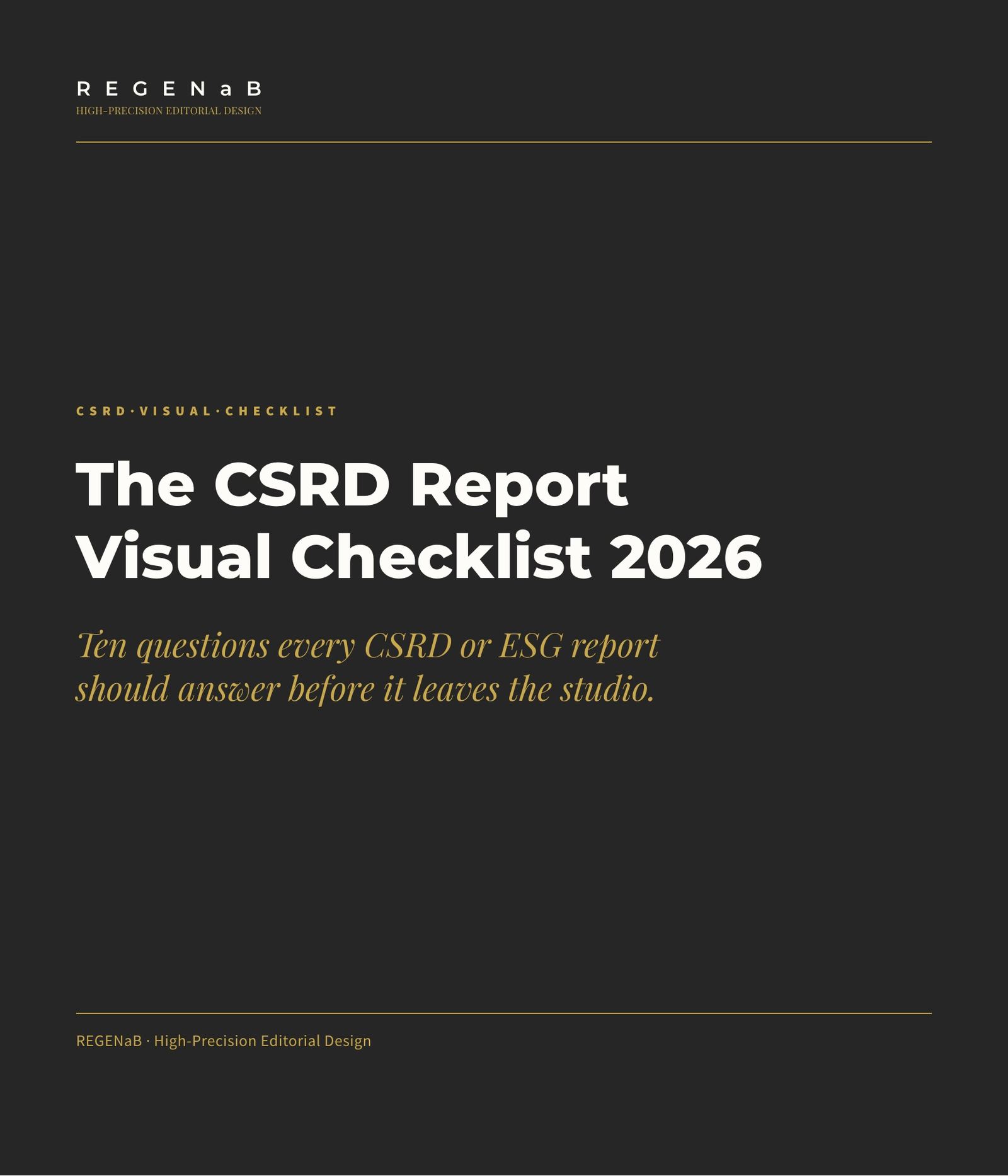
The CSRD Report Visual Checklist 2026 — cover, built natively in Adobe InDesign Free · 13 pages
Free for Sustainability & IR teams

The 13-page checklist Wave 1 issuers wish they had read.

A practical, designer-led audit framework for any CSRD or ESG report — built around the ten investor-grade questions above, with worked examples, before/after spreads and an InDesign architecture diagram. The guide is itself an artefact of the methodology it teaches.

  • The 10-point investor-grade diagnostic, expanded into 13 pages
  • An InDesign architecture map for a Wave 1 sustainability statement
  • Before / after spreads from Word-built vs InDesign-built reports
  • A one-page brief template you can hand to any designer
06 · Begin

Tell us about your report.
We reply with three
specific recommendations.

Answer six short questions about your CSRD or ESG reporting situation, and send the link to your most recent report if you have one. We read it cover to cover and return a one-page editorial assessment with three concrete moves — entirely async. No call to schedule, no deck. The written assessment is the work.

See the full studio enquiry form

Async · Takes about 3 minutes · Reply within 3 working days

07 · CSRD Practice FAQ

Questions Sustainability
and IR teams ask first.

Our company sits below the new Omnibus thresholds. Should we still report?

Many companies removed from mandatory scope still report voluntarily — typically because customers, banks or supply-chain partners are themselves Wave 1 and require ESG data from their value chain. The Voluntary SME standard (VSME) is the route EFRAG has signalled for this. The visual standard expected from voluntary reports is not lower than the mandatory one — often it is higher, because the report is read by the very stakeholders the company is trying to win.

We already filed our first CSRD report. Why rebuild the design system now?

Because the marginal cost of fixing the architecture in cycle two is a fraction of fixing it in cycle five. Most Wave 1 first reports were assembled under deadline pressure on top of inherited Word and PowerPoint workflows. Cycle two is the first cycle where the team has time to consolidate. The system you commit to now compounds — or it accumulates technical debt that is more expensive every year.

Does REGENaB handle the iXBRL tagging itself?

REGENaB designs the editorial system so the inline XBRL tagging vendor can apply tags without breaking the visual hierarchy — a coordination that is rarely done well when the two workstreams are separated. The tagging itself is typically handled by specialist software vendors (Workiva, AMANA, ParsePort and similar) or by the audit firm. We work alongside them; we do not replace them.

Can the design be reused for the next reporting cycle?

That is the whole point of the architecture. Paragraph styles, character styles, table styles, master pages, linked Excel data and modular ESRS sections are designed to be reused every cycle, not rebuilt. A well-built CSRD system produces year three at a fraction of the year-one cost.

How does the CSRD brief work?

You answer six short questions in the brief wizard and, if you have one, send the link to your most recent sustainability report. Within three working days we return a one-page editorial assessment with three concrete recommendations, ranked by impact. It is entirely async — no call to schedule, no presentation. The written assessment is the output, and it is yours to act on however you choose.

What is the indicative investment for a full CSRD report system?

For a Wave 1 cycle-two rebuild on a 60–120 page sustainability statement, indicative investment is £8,000–£18,000 (€9,500–€21,000), including the InDesign system, vector charts, table styles, master pages, PDF/UA tagging and Excel data link. For a Wave 2 preparation engagement spanning the architecture build plus a parallel dry-run report on FY2025 data, the indicative range is £12,000–£28,000. Precise quotes are issued after the editorial assessment.